Guestr.ai vs Messaging Autopilots: Why They're Different Tools for Different Problems
Both use AI. Both promise to save you time. But messaging autopilots and guest knowledge systems solve fundamentally different problems. Here's when each one makes sense.
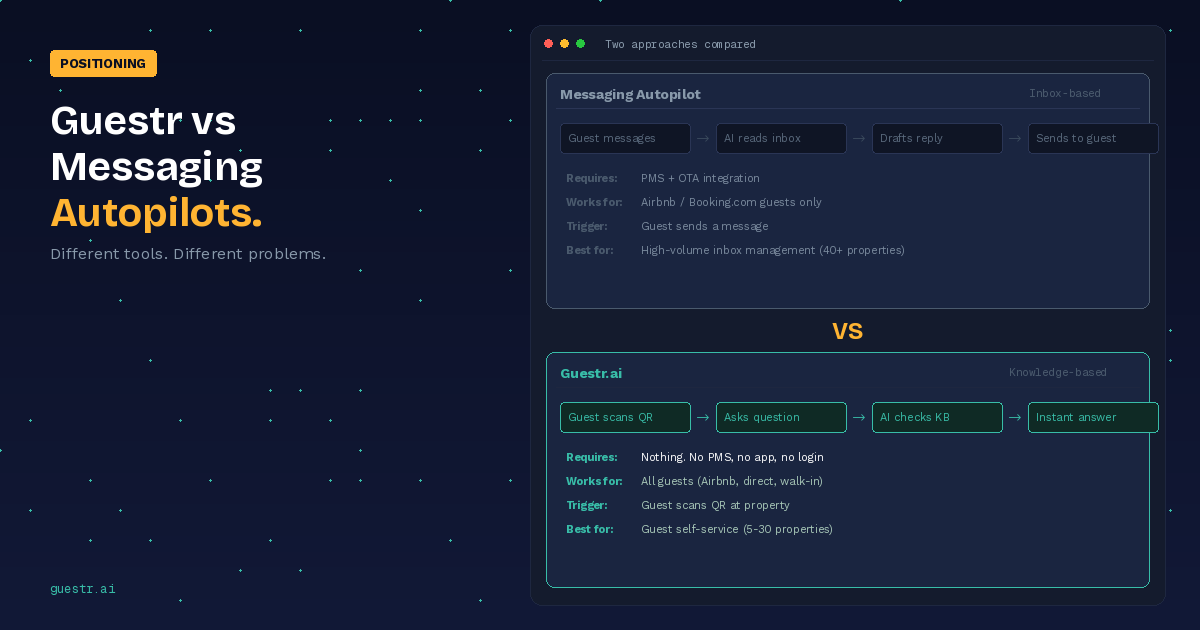
A property manager I know spent two weeks evaluating AI tools for his 15 properties. He'd narrowed it down to two: a messaging autopilot and Guestr. He asked me which one was better.
My answer was annoying but honest: they don't do the same thing, so "better" doesn't apply. It's like asking whether a dishwasher is better than an oven. Both belong in a kitchen. They solve different problems.
But I get why the confusion exists. Every tool in this space puts "AI" on the homepage and promises to reduce your guest communication workload. If you're a property manager shopping for tools, they look like competitors. They're not.
Here's the actual difference, and when each one earns its money.
What messaging autopilots do
A messaging autopilot sits inside your Airbnb or Booking.com inbox. Guest sends a message, the AI reads it, drafts a response, and either sends it automatically or holds it for your approval.
The good ones are impressive. They pull booking data from your PMS — guest name, check-in date, property details — and weave it into the reply. A guest messages "what time is check-in?" at 3am, and the autopilot responds with "Hi Sarah, check-in at your Lisbon booking is at 3pm. Here's the door code..." without you waking up.
They're built for inbox volume. If you manage 40+ properties on Airbnb and your inbox gets 50 messages a day, an autopilot can handle the majority of those without you touching them. That's real value.
But they have a built-in limitation that's worth understanding: they only work when a guest sends a message through the platform. No message, no automation. The guest who needs help but doesn't feel like messaging you? The autopilot never sees them.
They also require a PMS connection in most cases. The AI needs booking data to generate accurate replies, so if you're running without a PMS — and plenty of property managers with 5-15 properties are — the setup gets complicated or impossible.
What Guestr does
Guestr comes at the problem from the opposite direction. Instead of automating your responses, it eliminates the need for guests to ask in the first place.
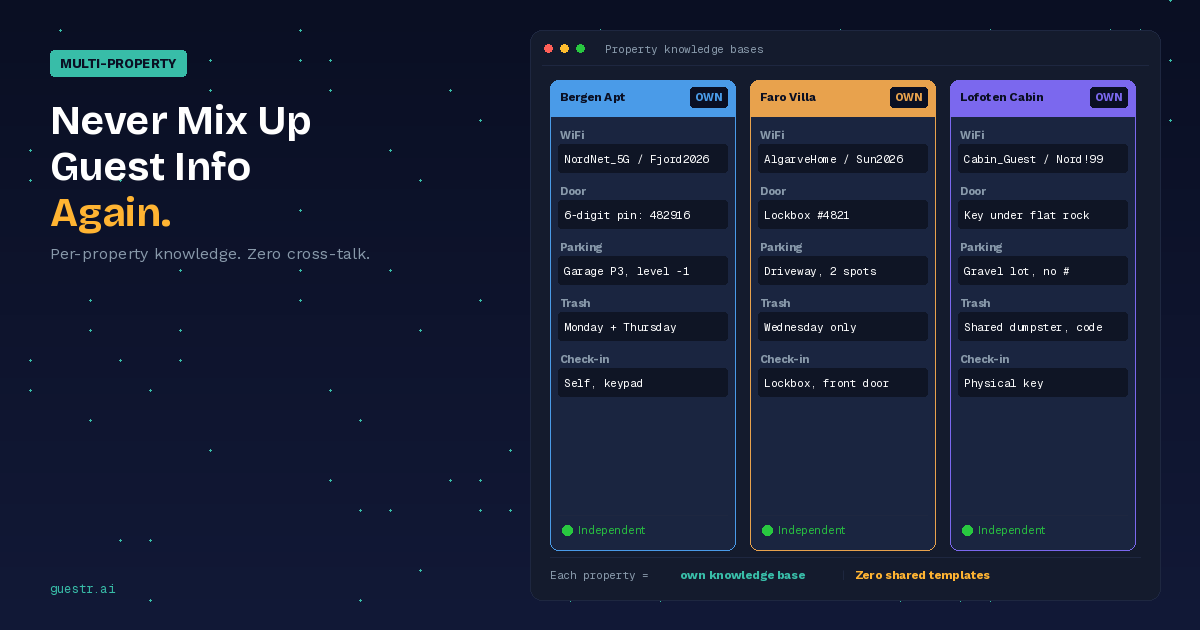
Each property gets a knowledge base — WiFi, parking, check-in, house rules, appliances, local tips, whatever guests typically need. A QR code at the property gives guests access. They scan it, type their question in whatever language they speak, and the AI answers from your approved content. No app to download. No account to create. No message sent to your inbox.
The guest who arrives at 11pm and needs the parking gate code doesn't message you. They scan the QR on the door and type "parking." The German couple who can't figure out the heating system asks in German and gets the answer in German. Your phone doesn't buzz.
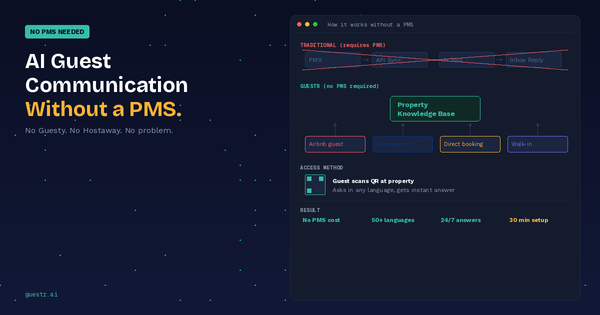
There's no PMS requirement because Guestr doesn't need booking data. It's not responding to messages — it's serving property information to whoever is physically at the property.
Two scenarios that show the difference
Let me make this concrete.
Scenario one: A guest at your Barcelona apartment messages through Airbnb at 2am asking where the TV remote is.
With a messaging autopilot, the AI picks up the message, checks your knowledge base or saved responses, and replies in the chat: "The TV remote is in the top drawer of the living room console." Fast, maybe 30 seconds. But the guest had to send a message and wait for a response, even if that wait was short.
With Guestr, the guest would have scanned the QR code in the living room, typed "TV remote," and gotten the same answer instantly. No message sent. You'd never know they had the question unless you checked the analytics.
Both solved the problem. The difference is that the autopilot handled a message that didn't need to exist.
Scenario two: A guest who booked directly — not through Airbnb or Booking.com — arrives and can't find the parking spot.
With most messaging autopilots, this guest has no channel to message through. They're not on Airbnb. They don't have the host's WhatsApp. They call you, or they figure it out on their own, or they leave annoyed.
With Guestr, the QR code works regardless of how the guest booked. Airbnb guest, Booking.com guest, direct booking, walk-in — doesn't matter. They scan the code and get the same information.
When a messaging autopilot makes more sense
I'd point you toward a messaging autopilot if:
You're running a large portfolio — 30, 40, 50+ properties — and your Airbnb inbox is out of control. You have a team and a PMS already in place. Your main pain point is the volume of repetitive messages hitting your inbox, and you want the AI to handle the easy ones so your team focuses on the complex stuff.
If that's you, tools like Hospitable, HostBuddy, or Aeve are worth evaluating. They're good at what they do.
You might also prefer an autopilot if most of your bookings come through OTA platforms and you don't get many direct bookings or walk-in guests. The "guest must message first" limitation matters less if all your guests are on Airbnb anyway.
When Guestr makes more sense
Guestr fits better when your inbox isn't the problem — your guests just can't find basic information about your property.
You manage somewhere between 5 and 25 properties. Your guests message you with the same questions every week: WiFi password, parking instructions, how the heating works, checkout time. You've answered each question dozens of times. An autopilot would automate your replies, but you'd rather guests just find the answers themselves.
You get international guests. Your properties serve German, French, Japanese, Brazilian travellers, and managing multilingual communication through inbox replies is a pain even when automated. Guestr handles 50+ languages from the guest side — the guest asks in their language, gets the answer in their language.
You have direct bookings. Maybe you're building a direct booking channel, or you manage properties for owners who get their own bookings. These guests don't go through Airbnb, so inbox-based tools can't reach them.
Or you just don't use a PMS. You've been managing fine with spreadsheets and direct OTA access, and you don't want to add a PMS just to qualify for an AI messaging tool. Guestr doesn't require one.
Can you use both?
Yes. Some property managers do.
The autopilot handles whatever comes through the Airbnb and Booking.com inbox — booking questions, change requests, post-stay follow-ups. Guestr handles everything that happens at the property — the on-site questions that guests would otherwise send as messages or just not ask at all.
They don't overlap much. The autopilot catches what comes through Airbnb and Booking.com chat. Guestr catches the stuff that never becomes a message — the guest who scans the QR instead of opening the app to type something.
If I had to pick one, I'd base it on where my biggest pain is. Inbox drowning? Autopilot. Guests can't find information? Guestr. Both? Maybe both tools, or start with the bigger pain point and add the other later.
Full disclosure: I built Guestr, so take my perspective with that context. But I've been deliberately honest about what messaging autopilots do well because I think the worst thing for property managers is buying a tool that solves the wrong problem. If your issue is inbox volume, Guestr won't fix that. If your issue is guests not finding information, an autopilot won't fix that either.
Pick the tool that matches your actual problem.
Try Guestr free — no PMS required →
Previously: Managing 10+ Properties? Here's How to Never Mix Up Guest Information Again