How AI Gap Detection Prevents Bad Reviews Before They Happen
Most bad reviews aren't about dirty towels or broken AC. They're about information that wasn't there when the guest needed it. Here's how to find those gaps before your next guest does.
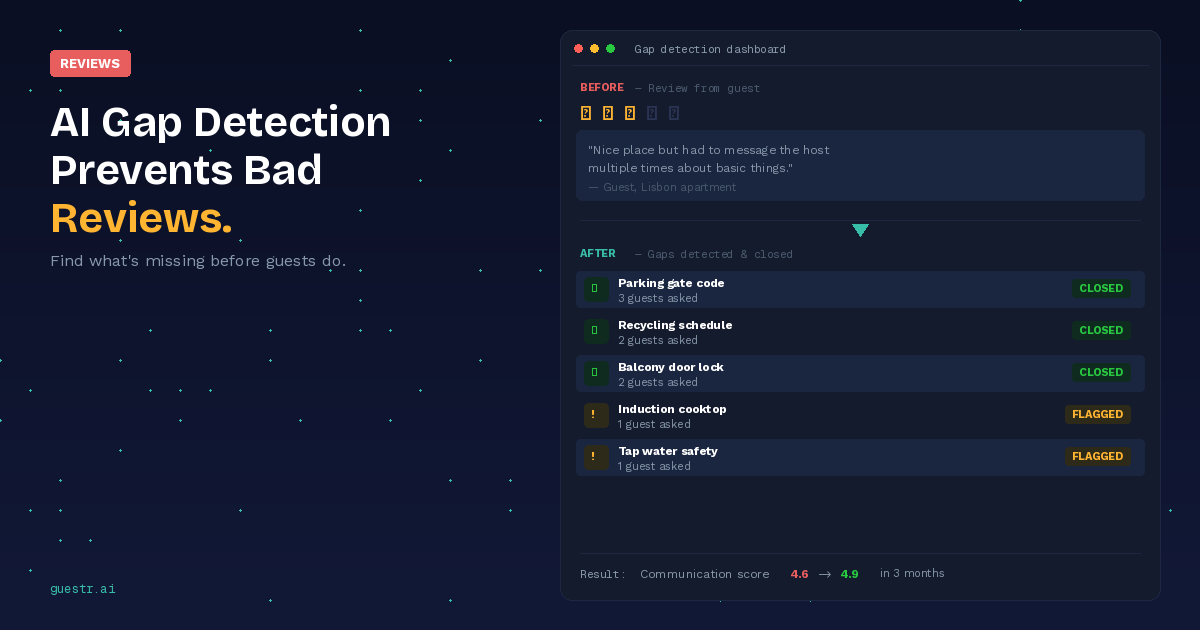
I got a 3-star review last year that still bothers me. The property was clean, the location was great, check-in went fine. The review said: "Nice place but had to message the host multiple times about basic things. Would have appreciated better information upfront."
That's a 3-star review on a 5-star property. And the guest was right — they asked about the parking gate code, the recycling schedule, and whether the balcony door locked from inside. Reasonable questions, every one of them. And I had the answers — I just never thought to put them anywhere a guest could find them.
Where most bad reviews actually come from
Read through your 3- and 4-star reviews — not the 1-stars (those are usually legitimate complaints about cleanliness or maintenance). The reviews that sit in the 3-4 range often have a specific tell. The guest liked the property. They just felt like they had to work too hard to figure things out.
You see phrases like "no one told me," "I had to ask three times," "not clear how to." None of these guests are angry. They liked the place. The stay was fine — just not great, because they spent twenty minutes trying to figure out the heating system or couldn't find parking because nobody mentioned the gate requires a code after 9pm.
I went through six months of my own reviews across all properties. Communication-related issues showed up in roughly half of every review that wasn't a 5-star. The communication wasn't bad — it just wasn't there. Things I assumed were obvious and never bothered to say.
What an information gap actually is
It's not a factual error. Your WiFi password isn't wrong — it's just that the guest couldn't find it at 11pm because it was buried in a message they received twelve hours earlier.
An information gap is an omission. Something the guest needed to know that isn't in your property's information system — or is there, but not findable at the moment they need it.
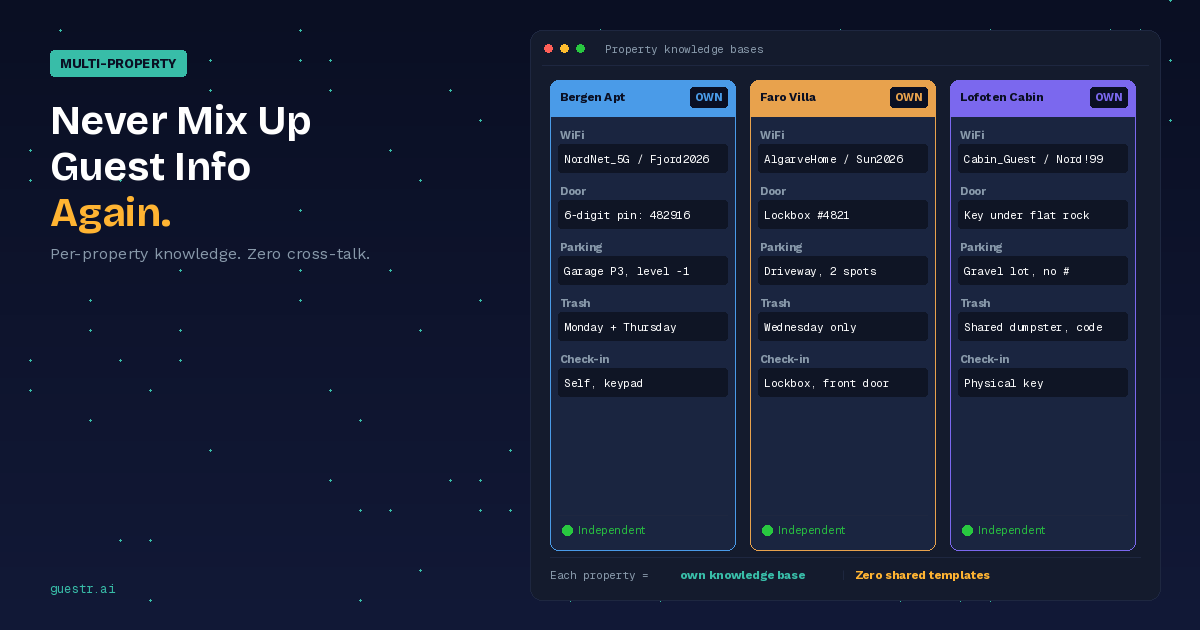
Some gaps are obvious once you see them. The trash schedule that varies by municipality — your local properties have Monday collection, the coastal ones have Wednesday, and the mountain cabin uses a shared dumpster with a code. None of this made it into your guides because at each property you just... know when to take the trash out.
Other gaps are sneaky. The WiFi extender in the back bedroom that guests need to connect to separately. The fact that the hot water takes 90 seconds to arrive at the kitchen tap. The parking space that's technically #14 but everyone calls it "the one behind the blue container." These are things you'd mention in person during a walkthrough. They never make it into a written guide because they don't feel important enough to document.
Until a guest can't figure them out at 10pm and leaves a review about it.
The manual way to find gaps (and why it plateaus)
There's a decent low-tech approach: walk through your property as a stranger. Arrive at the door. Can you get in? Where do you put your car? How do you turn on the heat? Is there a light switch you need to know about? What happens when the WiFi drops?
I did this at all my properties after that 3-star review. Found eleven things I'd never documented. Felt productive. Added them all to my guides.
Then, two months later, a guest asked about something I hadn't thought of during the walkthrough — how to use the induction cooktop. Apparently not everyone has used one before. A month after that, someone wanted to know if the tap water was safe to drink (it is, but I'd never said so).
The walkthrough catches the big stuff. But gaps keep appearing because every guest brings different assumptions and different experience. A guest from Japan has different expectations than a guest from Norway. You can't predict all of them by walking through the apartment yourself.
The other manual approach — reading your message history and cataloguing questions — works better but doesn't scale. At three properties, you can do it over a coffee. At twelve, it's a research project.
What AI Gap Detection actually does
This is where I'll be direct about Guestr, since Gap Detection is one of our features.
The concept is simple: Guestr tracks what guests ask through the QR-based knowledge system. When multiple guests at the same property ask questions that the knowledge base can't answer well, that topic gets flagged as a gap.
So if three guests in April all ask some version of "how does the parking gate work" at your Lisbon apartment, and your knowledge base doesn't have a clear answer for that, you get a notification: parking gate access is an information gap at this property.
You write the answer once — "The underground parking gate opens with the grey remote on the key hook. Press the button from inside your car, wait for the gate to fully open, then drive in. After 9pm, the gate auto-closes in 15 seconds." — and the next guest who asks gets that answer instantly, in their language.
What makes this different from just reading your messages: the system catches patterns across all your properties simultaneously. Maybe only one guest per month asks about the parking gate at each property — easy to miss in your inbox. But across twelve properties, that's twelve parking-related gaps you're not seeing because each one looks like a one-off.
From gap to fix: what the workflow looks like
When Guestr flags a gap, it's not just a notification. It tells you what guests are asking and that your knowledge base doesn't cover it well. The fix is usually fast:
At my Faro property, the system flagged "pool hours" as a gap. I'd assumed guests would see the sign by the pool. They didn't — they asked through the QR system instead. Took me two minutes to add pool hours and the rules about showering before entry. That question stopped coming in.
At the Oslo apartment, it flagged "grocery store nearby." I'd put a restaurant list in the guide but nothing about groceries. Added the two closest options with walking directions. Done.
Not every gap is this quick. Sometimes the flag reveals something actually missing from your setup — like when guests kept asking about airport transport at a property where I'd never documented it because I don't fly into that airport myself. That one took some research.
The point isn't that every gap takes two minutes. It's that you know about the gap before your next guest writes a review about it.
What this means for your review scores
I'm not going to claim that gap detection alone moves your ratings from 4.2 to 4.8. Too many variables in play — cleanliness, location, accuracy, the guest's mood, whether their flight was delayed.
But here's what I can say from my own numbers: after three months of actively closing information gaps, my "communication" sub-score went from 4.6 to 4.9 across all properties. And the number of mid-stay messages from guests asking basic questions dropped by roughly 60%.
That second metric matters more than it sounds. Every question a guest has to ask you is a small friction point. Individually, none of them ruins a stay. But four or five of them over a weekend add up to "nice place, communication could be better" — exactly the kind of review that costs you bookings without feeling dramatic enough to fight.
I'm not saying guests should never message you. Some want to chat, want recommendations, want a personal touch. But the messages where someone asks "what's the WiFi password" at 11pm — those should be zero. Those are unnecessary messages — the ones where the guest had to ask because the answer wasn't available.
Start with one property
If you manage multiple properties, don't try to audit all of them at once. Pick the one with the lowest communication score, or the one where guests message you most. Run through the walkthrough test. Read the last twenty messages from guests at that property. Look for patterns.
If you want the AI-assisted version, Guestr's Gap Detection is included in every plan. Set up one property, let it collect a couple of weeks of guest interactions, and see what it flags. You'll probably be surprised by what you've been missing — I was.
Run a gap audit on your first property — free →
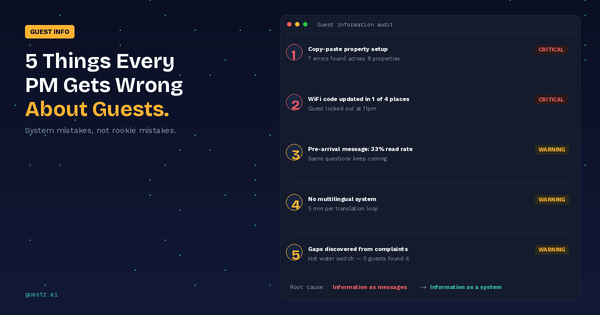
Previously: 5 Things Every Property Manager Gets Wrong About Guest Information