The Complete Airbnb House Manual Checklist (2026)
Most house manual advice is written for hosts with one Airbnb. This isn't that. If you're managing multiple properties and your guests are still messaging you about the WiFi, the problem isn't the guests — it's where the information lives and when they can find it.
You write the house manual. You include the WiFi password. You send it in the pre-arrival message. And on Saturday at 10pm you still get: "Hi, what's the WiFi?"
Every property manager with more than a few listings has been there. Three in a row asking the same thing is the universe telling you the information exists, but guests aren't finding it.
This guide is for people managing multiple properties — not solo hosts who know their one apartment by heart. If you're running 5, 10, 20 listings and need a system that actually holds up across all of them, here's what we've learned works.
What a house manual is actually for
Airbnb has an official "house manual" field in the listing editor — a text box that confirmed guests can see. Most property managers use the term loosely to mean whatever resource they use to deliver property information during a stay: printed binder, PDF, digital guide, it doesn't really matter what you call it.
What matters is what it's trying to do. The goal isn't to inform guests. It's to get them answers before they ask you. Those are different things. A well-informed guest who had to message you to get that information still became a message in your inbox.
The reason most house manuals don't fully achieve this is that they're built around what hosts want to share, not when guests actually need things. Everything goes into one document, delivered once, before the guest arrives. Then they're standing at the front door at midnight and they're not opening a PDF — they're calling you.
The sections below are ordered roughly by how often they generate guest messages when they're missing or unclear.
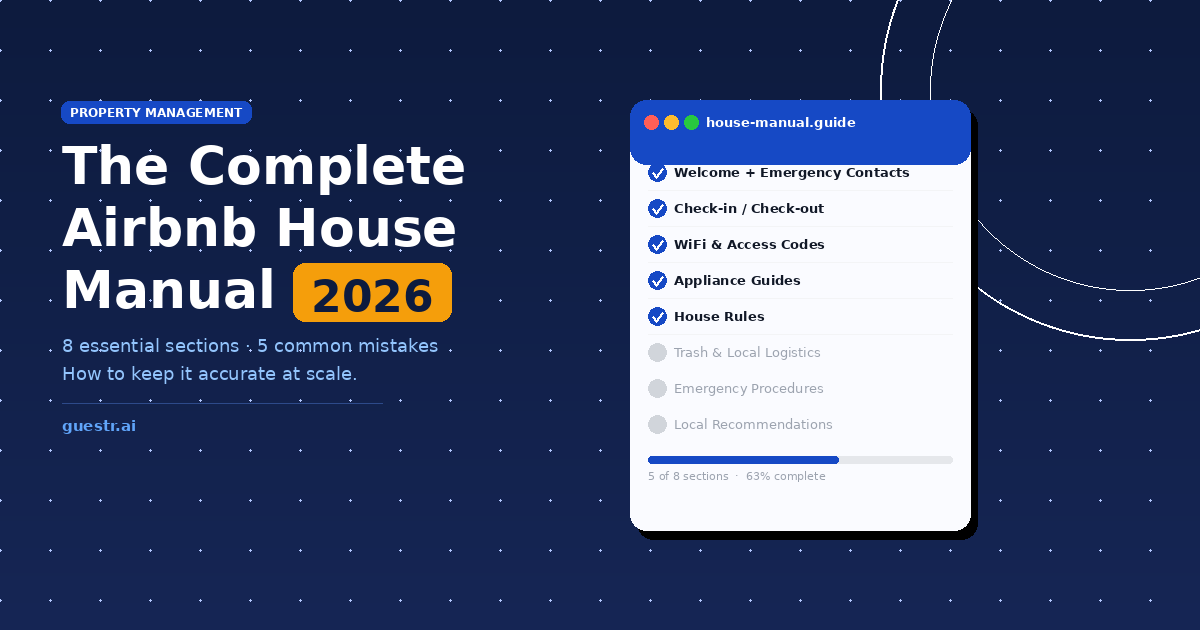
The 8-section checklist
1. Welcome message and emergency contacts
Keep the welcome short. Two or three sentences at most — guests aren't reading preambles, they're scanning for the thing they need. Save the warmth for the actual stay.
What shouldn't be short: the emergency information. Phone number for you, local emergency services (112 in Europe, 911 in the US), and the nearest hospital. Put it at the top of this section, not at the end of the document. If something goes wrong, a guest is not paging through your restaurant recommendations to find it.
Also worth including: building management contact if the property is in a managed building, and whether there's a physical key override if the smart lock fails.
2. Check-in and check-out
This section alone eliminates the majority of pre-arrival messages when it's done right. The key is to assume nothing.
For access: don't say "the key box is on the front door." Say "green metal key box, right side of the front door, shoulder height, next to the intercom." Assume your guest is arriving after dark, carrying luggage, in a neighbourhood they've never been to. Write for that person.
For smart locks: include what to do if the battery dies. It will die, eventually, and it will happen at the worst possible time.
Checkout instructions work better as a numbered list than a paragraph. Strip the beds, put used towels in the bathtub, run the dishwasher, close the windows, leave the key in the box. Sequential. Unambiguous. No interpretation required.
3. WiFi
The single most asked-about thing across short-term rentals everywhere. It should take a guest under ten seconds to find it.
The practical details: exact network name (copy-paste the SSID exactly — capitalisation matters), exact password, which network to use if there are multiple, and where the router is in case they need to restart it.
One thing worth knowing if you manage multiple properties: WiFi credentials are the information most likely to drift between what's in your manual and what's actually at the property. We'll come back to that.
4. Appliances
Usually the longest section, and rightly so. The rule I'd apply: if an appliance has a non-obvious quirk, explain it. If it works exactly like it does in every other home, skip it.
The shower that takes 45 seconds to run hot — mention it. How to turn on a lamp — don't.
For anything that requires multiple steps, use numbered instructions. Guests follow steps. They don't parse complex sentences while standing in front of an unfamiliar thermostat.
Things that tend to generate questions when undocumented: heating and cooling controls, the washing machine (and where the detergent is), the TV and any streaming logins you've set up, the coffee machine, anything smart or automated, and the oven if it has non-standard ignition. If there's a circuit breaker panel, include where it is and how to reset a tripped circuit.
5. House rules
Include the main rules in the manual even if guests accepted them at booking. By the time they arrive, they've forgotten. Having rules present in context — next to information about the property, not in a separate policies section they signed weeks ago — is more effective.
Three to seven rules that actually matter is better than twelve that include obvious ones. If a rule needs context to make sense, give one sentence of reason: "No parties or events — the building has shared walls and a noise restriction after 10pm." That lands differently than just "no parties."
6. Trash and local logistics
This is the section most house manuals skip, and it punches above its weight in terms of guest messages. Partly because it's specific to each property and can't be templated, partly because guests genuinely don't know the local rules.
Trash collection days, where to put the bins, how recycling is separated — these vary significantly by municipality and guests have no way to know them. For properties in Scandinavia or Germany where recycling categories are detailed, this section alone can prevent multiple mid-stay messages per booking.
Include any local restrictions worth knowing: noise regulations, parking rules on specific days, water restrictions in summer if applicable.
7. Emergency procedures
Where's the fire extinguisher. Where's the first aid kit. What to do if the fire alarm goes off. Where's the electrical panel and how to reset a tripped circuit. For buildings with lifts: what to do in a power outage. For properties in areas with seasonal risks: include the relevant local guidance.
This section has one strict requirement: it needs to stay accurate. If the fire extinguisher moves, the manual is updated before the next guest.
8. Local recommendations
This is where you can add genuine value rather than just logistics. Five to ten restaurant recommendations across price points, the nearest supermarket and pharmacy, public transport options (specific routes, how to buy a ticket, which apps work locally), and a couple of local spots that don't appear in the first page of Google results for your city.
The test: if a guest can find it in five minutes of searching, it's not adding much. The neighbourhood café that's worth seeking out, the market that only runs Thursday mornings, the viewpoint locals actually use — that's what makes a recommendation worth including.
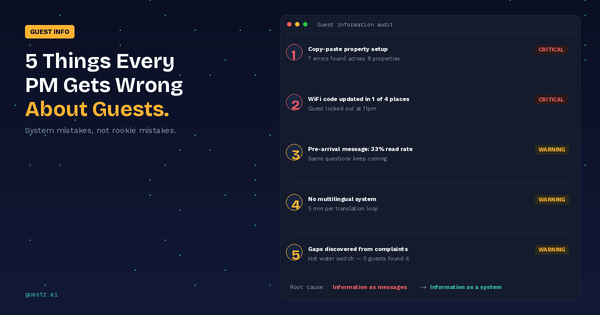
5 mistakes that don't matter much at one property but break things at scale
Copying one property's manual and using it for another
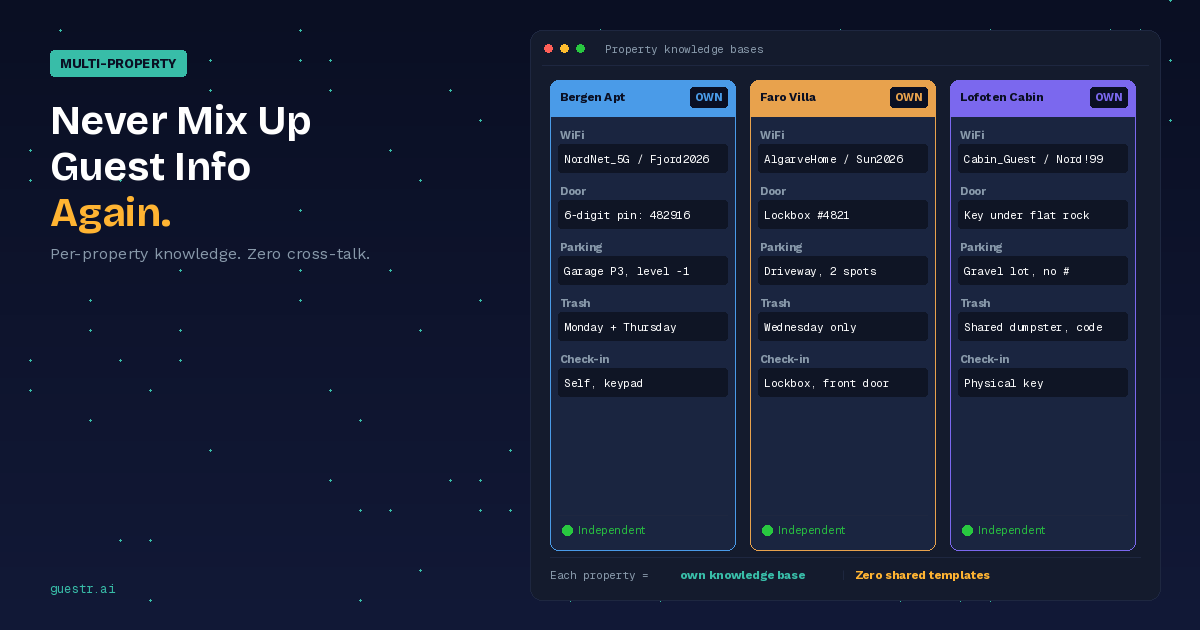
At ten properties, building a single template and adapting it for each sounds efficient. The problem is what doesn't get adapted: WiFi credentials, access codes, specific appliance models, parking instructions, trash collection days. A guest at Property A receiving Property B's check-in code is locked out on arrival.
This happens more often than anyone likes to admit. The only real fix is treating each property's manual as its own document. Copy the structure, never the content.
Updating information in one place and forgetting the others
The WiFi password changed at Property 7. You updated the Airbnb message. You forgot the printed binder. The next guest tries the binder password. You get a call on Friday evening.
The underlying problem is that property information tends to live in multiple places at once — Airbnb listing, quick reply templates, digital guidebook, printed binder, shared team document. None of them talk to each other. When something changes at the property, all of those copies need updating, which rarely happens consistently under pressure.
The straightforward approach: one source of truth per property. Everything else references that, and when the source changes, everything else gets checked before the next guest arrives. Not eventually. Before.
Assuming guests read the pre-arrival message
Most don't — or at least not carefully. Airbnb messages get skimmed on mobile, often days before the trip when guests have other things going on. By the time they actually need the check-in code, they've forgotten where they saw it.
The guest who "didn't read the instructions" often did. They just didn't retain them at the moment they needed them. Designing the manual for the guest sitting at home planning their trip is the wrong mental model. Design for the guest standing outside the front door at midnight, slightly stressed, phone in hand.
Critical information — the door code, the WiFi — needs to be findable in under ten seconds. That's the standard to build to.
Writing everything in one language
If you're managing properties in tourist destinations, a meaningful share of your guests aren't native English speakers. Or whatever language your manual is written in. Instructions that are technically present but practically inaccessible for a Japanese couple or a French family are not actually doing the job.
The options are: translated versions of at least the critical sections, or a format that lets guests access information in their own language. Neither is trivial to maintain at scale, but ignoring it means those guests are just sending you messages instead.
Not knowing what you've left out
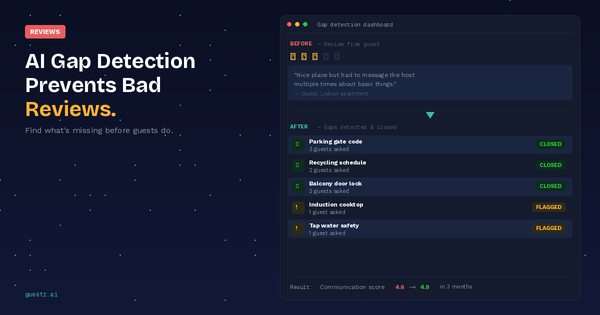
The gap in your house manual isn't the section you forgot to write — it's the section you didn't know was missing. The parking gate code that "everyone knows." The trash schedule that changes in summer. The appliance quirk that only matters in certain weather.
These gaps surface when guests ask about them. By the time you know they exist, someone has already been inconvenienced — and that inconvenience tends to show up in the communication section of their review.
A useful exercise: look at your last 30 guest messages and group them by topic. Any topic that shows up more than twice is either missing from your manual or not clearly enough written.
PDF vs. digital: what actually holds up as your portfolio grows
A printed binder looks good and doesn't need a battery. A PDF costs nothing to create and is easy to send. Both have the same structural problem: once created, they require active effort to stay accurate. At two properties that's manageable. At fifteen, with information changing at different rates across different listings, it quietly becomes the thing that breaks.
Digital guidebook platforms — Touch Stay, Hostfully, and others — solve part of this. Change the WiFi password in one place and every future guest sees the updated version. They also support photos of appliance controls, video walkthroughs, links you can actually click.
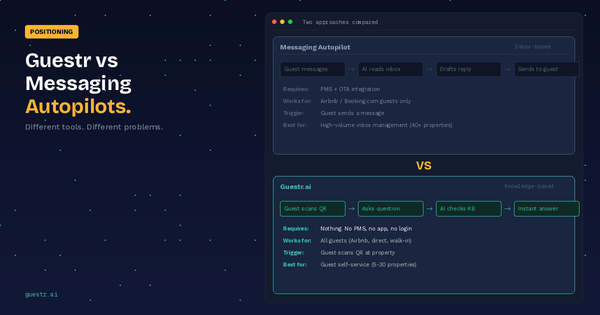
The next step beyond that is interactive: rather than guests scrolling through pages to find what they need, they can ask directly. Tools like Guestr.ai approach this differently — guests scan a QR code at the property and ask questions in their own language, and the system answers from the knowledge base the manager has built for that property. If the information isn't there, it says so rather than guessing. For managers with guests arriving from a dozen different countries, that changes what "the information is available" actually means in practice.
The right format is the one you can keep accurate across your full portfolio. For a small operation with English-speaking guests, a well-structured digital page is probably enough. The more properties and the more diverse the guests, the more the maintenance overhead of static content starts to add up.
Keeping it accurate when things keep changing
Building the manual is straightforward. Keeping it accurate is the actual ongoing work.
What seems to work: treating any change at a property — a new door code, a replaced appliance, a router swap — as an immediate trigger to update the manual before the next guest checks in. Not "at some point soon." Before the next guest.
A quarterly check across all properties — going through each manual and verifying that the information is still correct — catches the things that drift without triggering an obvious update. Twenty minutes per property per quarter is a lot less expensive than the guest message, the bad review, or the rebooking issue that comes from outdated information.
For new properties: the handover inspection is the best moment to build the manual. That's when you have access to the actual access codes, the appliance models, the specific parking situation. Do it then, not after the first guest has already arrived and found something missing.
Conclusion
A good house manual doesn't need to be beautifully designed or exhaustive. It needs to answer the questions your guests will have, at the moment they have them, in a format they can actually use.
Start with the eight sections above. Run your existing manuals against the five mistakes and see what comes up. Then think honestly about what format will still be maintainable a year from now, when the portfolio is bigger and the guests are coming from more places.
Want guests to be able to ask questions and get instant answers from your property content — in any language? Guestr.ai builds a per-property knowledge base that guests access via QR code. No app download, no guessing. Start free →