Why Scheduled Messages Aren't Enough for Guest Communication
Scheduled messages handle the routine touchpoints. But most guest questions arrive between them — at 11pm, in a language you didn't anticipate, about a quirk specific to one property. Here's what the gap looks like and what actually fills it.
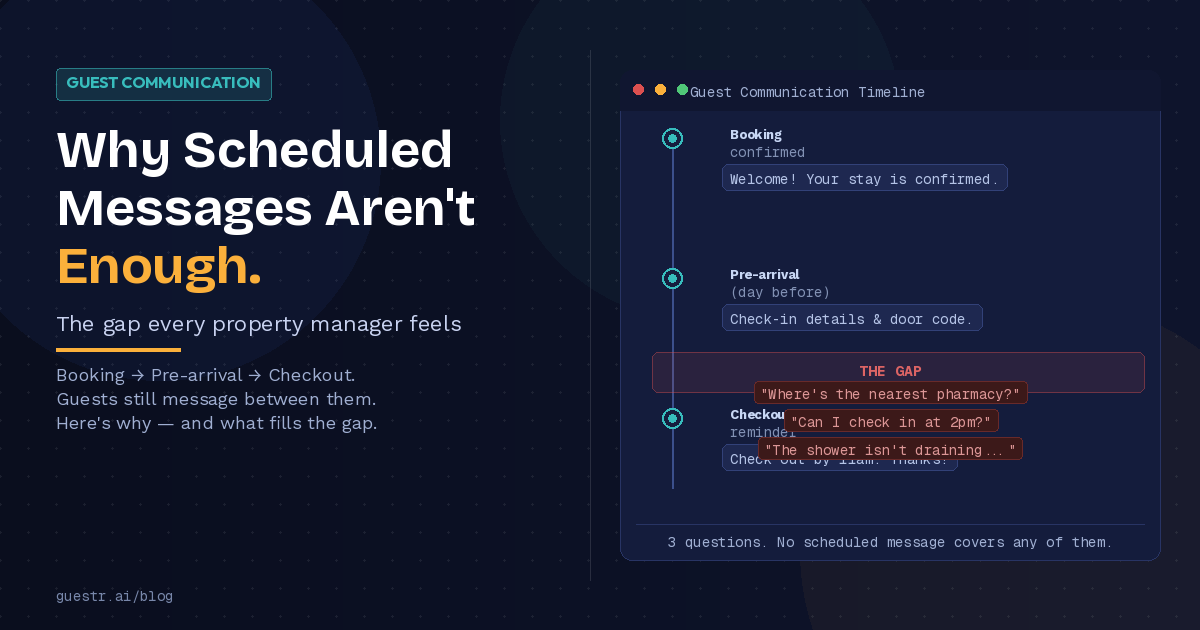
You set up scheduled messages, it took an afternoon, and for a week or two things felt genuinely sorted. Booking confirmation goes out automatically. Check-in details land the evening before arrival. Checkout reminder fires at 8am. You did the work, you're not doing it again every booking.
And guests still message you. Not because something went wrong — because they have a question that doesn't map to any of the four moments you planned for.
This isn't a scheduled messages problem, exactly. They work. They just don't work for what people think they work for. If you're still fielding guest messages that feel like they should have been answered already, the gap isn't in how you wrote your templates.
What the typical setup actually covers
Most Airbnb guest communication sequences look roughly the same: a booking confirmation (usually automated by the platform), a pre-arrival message with the access code and WiFi somewhere in it, maybe a mid-stay check-in that most guests don't reply to, and a checkout reminder. Some property managers add a post-stay review request.
That's four moments. Confirmation, check-in, mid-stay, checkout. Clean and predictable.
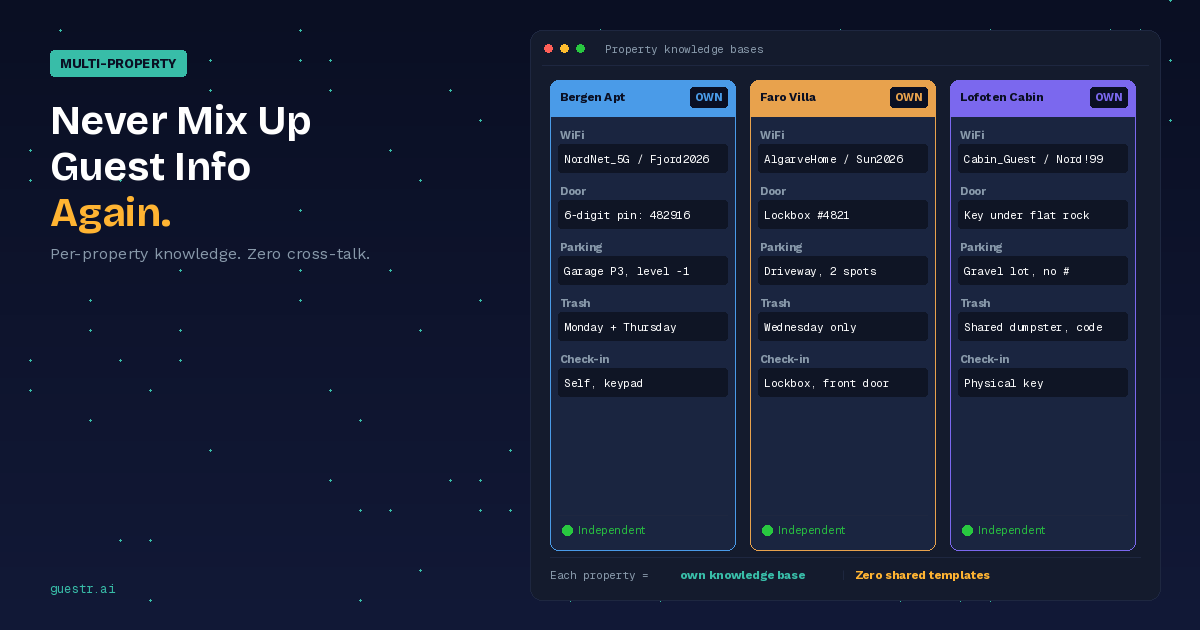
The problem is that a three-night stay is hundreds of moments — and most of the questions guests have don't land at any of those four. They land on Saturday afternoon when someone can't work out how the shower pressure control works. They land at 10pm when a guest wants to know if the parking they've been using is actually theirs or if they've been in someone else's spot all day. They land the morning of checkout when someone wants to extend because their flight got pushed.
Your pre-arrival message doesn't cover any of that. It was never going to.
The messages you're actually responding to
Here's a useful exercise: go back through your last 30 guest message threads and count how many were questions your scheduled sequence already covered. In my experience talking to property managers, it's rarely more than a third. Usually less.
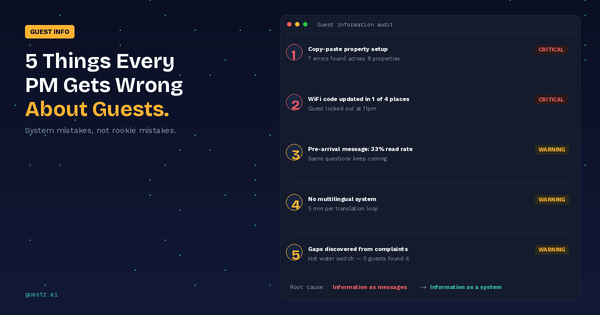
The rest are the specific, reactive, time-sensitive ones. Someone scanning the kitchen for where you keep extra bin bags. A guest who skimmed the pre-arrival message on a crowded train and can't find the WiFi password now that they're standing in the apartment. An Italian couple who messaged in Italian asking something your quick-reply template doesn't have an equivalent for.
None of these are unusual. None of them are your fault either — you can't write a scheduled message for every possible question across every property. But they do accumulate. And at 10 or 15 properties, they accumulate into a chunk of your week that's hard to claw back.
Host-initiated vs. guest-initiated — why it matters
The thing that scheduled messages are fundamentally built for is host-initiated communication. You decide what guests need to know, you write it, you set the timing, it goes out. The whole system runs on your prediction of what information is needed and when.
That prediction is pretty good for the structured moments — arrival, departure. It gets shakier everywhere else.
Guest-initiated communication is different. The guest has a specific question right now, based on what they're doing right now. It might be something you've answered fifty times before but haven't templated because it only comes up at one property. It might be in Spanish, because this guest doesn't speak English well and your entire message sequence is in English. It might arrive at 1am on a Sunday.
What you have is a system built to anticipate. What guests do is ask. Those two things are only partially aligned — and the misalignment is where most of the friction sits.
What's actually missing
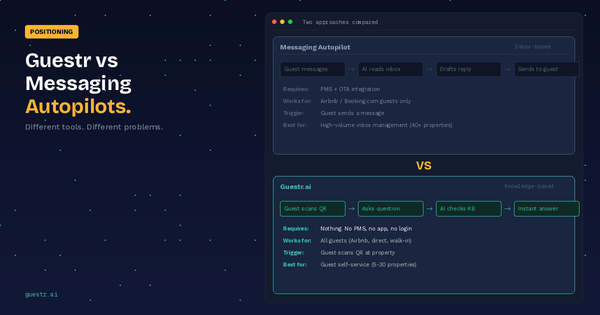
When property managers tell me their Airbnb guest communication still feels like a lot of work despite having automation set up, the pattern is almost always the same. They have the scheduled messages. They have a good set of quick replies. What they're missing is something that handles guest-initiated questions without them being involved.
Not a generic FAQ nobody reads. Not a link to an Airbnb help page. Something that can answer "where's the nearest 24-hour pharmacy from this apartment" with a real answer, at midnight, in the language the guest is asking in, based on information you've actually approved.
That's a different thing from scheduled messages — not a replacement, an addition. The scheduled sequence still handles your four routine moments. But when a guest has a question between those moments, there's somewhere for it to go that isn't your phone.
Property managers who've added that layer describe it the same way: not that they get zero messages, but that the messages they do get are the ones that actually need them. A maintenance issue. A guest who's had something go wrong and needs to talk to a person. Not "what time is check-out" at 11pm.
The multilingual piece
This is worth its own section because it changes the math significantly if you manage properties in tourist-heavy areas.
Your scheduled messages are probably written in English. Maybe you've done a few manual translations for your German or French regulars. But across a full season — a property in Lisbon, say, welcoming guests from Brazil, Germany, the Netherlands, Japan, South Korea — you can't manually translate and maintain templates for every language.
So what happens? The pre-arrival message goes out in English. The German guest reads it well enough. The Japanese guest does their best. When they have a question mid-stay, they'll try in broken English, or use Google Translate to message you, or just not ask and muddle through. None of those are great outcomes for review scores.
A system that can actually respond in the guest's language — not a machine-translated copy of your template, but a response to their specific question — solves a problem that no amount of scheduled message optimization touches.
The practical version of this
You don't need to rebuild anything. Scheduled messages are still worth having — they handle a real load of routine communication and guests expect them.
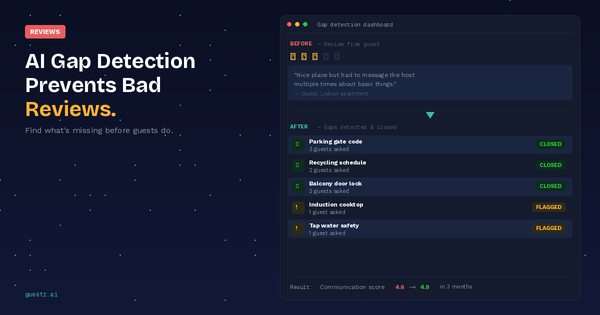
But if you're spending meaningful time on reactive guest messages — answering questions that feel like they should have been answered already, dealing with questions in languages your templates don't cover, getting messaged about things that are definitely in your pre-arrival information somewhere but that guests can't find — that's not a problem more templates will fix.
The framing that's stuck with me: scheduled messages are what you send to guests. The gap is what happens when a guest needs something you didn't send.
See how Guestr handles the questions your scheduled messages miss. Start free →