Digital House Manual Software Compared: 5 Tools for Property Managers (2026)
The same label covers tools that do completely different things. Here's what five digital house manual options actually cost per property, where each one breaks down, and which type fits how you work.
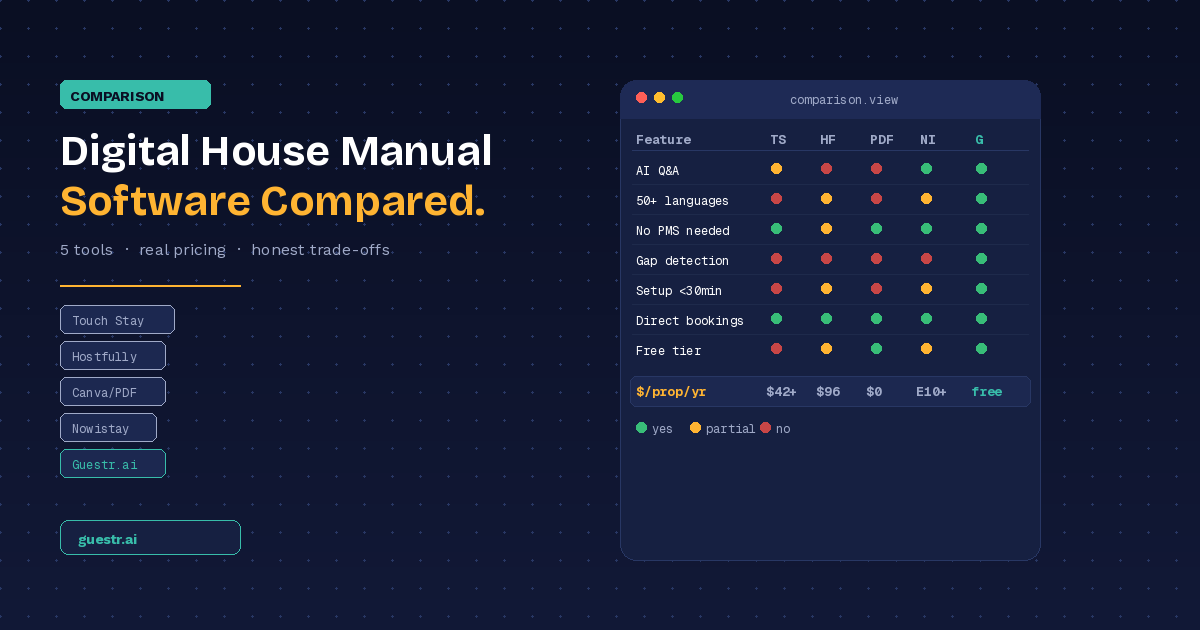
If you've searched for digital house manual software recently, you've probably noticed that the category is hard to pin down. The same label gets applied to tools that do very different things — from static PDF templates to AI systems that answer guest questions in real time. Some are standalone products. Some are add-ons bundled inside a property management system. Some are free. Some cost more than your cleaning rotation per property.
If you're running more than a handful of properties, the challenge isn't finding a tool — it's understanding what you're actually looking at. A beautifully designed static guide and an AI-powered Q&A system are both called "digital house manuals," but they work in fundamentally different ways. Picking the wrong category wastes money. Picking the right one saves hours every week.
Here's what five common options actually do, what they'll cost you at 10+ properties, and where each one breaks down.
What to look for when evaluating digital house manual software
Before getting into individual tools — a few things that actually matter once you're past three properties.
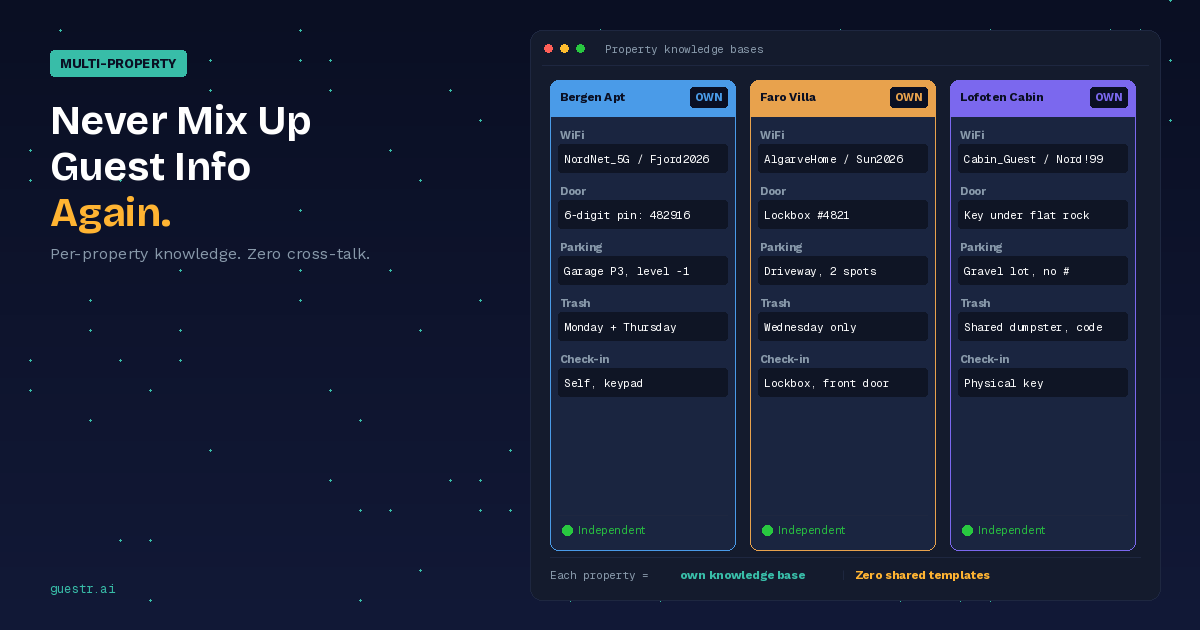
Can you manage each property's information separately without rebuilding from scratch? At 15 properties, a tool that needs manual updates per property is just creating a different kind of maintenance headache.
How does translation work? If you're hosting international guests — and if you're in any tourist market, you are — a tool that only supports languages you've manually translated will always have gaps. There's a real difference between automatic translation and "create a separate version in German and hope you keep both updated."
Does the tool answer questions, or does it show information and hope the guest finds it? A static guide works for guests who read. An interactive one works for guests who don't. These are different people.
And then the pricing question nobody wants to think about: what does this actually cost at 10 or 20 properties? The price on the marketing page is usually for one listing. Per-property pricing compounds fast.
Touch Stay — best for beautifully designed static guides
Touch Stay is one of the most established names in the digital guidebook space, and the product reflects that maturity. The guides themselves look polished — guests get a branded, mobile-friendly link with sections for check-in, house rules, local recommendations, and property-specific instructions. Property managers report that well-built Touch Stay guides reduce inbound guest questions by 50–80%, which is a real number if you're currently fielding a lot of repetitive messages.
What Touch Stay does well is presentation. The guides are visually clean, they work offline, and the platform has an engaged community of hosts sharing best practices. There's an AI chatbot feature that can answer guest questions based on the guidebook content, which adds an interactive layer on top of the static guide.
Pricing starts at $99 per year for a single property. As you scale, the per-property cost drops — roughly $42 per property per year at 20 properties. All features are available on every plan regardless of price.
The main limitation for property managers at scale is integration. Unless you're using OwnerRez or BookingSync, Touch Stay doesn't connect directly to your PMS, which means sending guidebook links to guests is a manual step or requires a workaround. Translation is also manual — you'll need to create separate versions of your guide for each language, which gets time-consuming if your guest base is internationally diverse.
If what you need is a polished, well-designed guide that reduces questions on its own — and your guest base mostly speaks the languages you've already built guides for — Touch Stay does that job well.
Hostfully Guidebooks — best for Hostfully PMS users
Hostfully started as a guidebook platform and later expanded into a full property management system. The guidebook product still exists as a standalone offering, and it's a solid option — particularly if you're already using or considering Hostfully as your PMS.
The guidebook builder is straightforward. You can pull in local recommendations and maps from Google, add your own property-specific content (house rules, appliance instructions, photos, videos), and share via a simple link. One of Hostfully's notable features is automatic translation into 16+ languages, which is a real advantage over tools that require you to manually create translated versions.
Hostfully also includes a Viator affiliate integration — guests can book local activities through your guide, and you earn an 8% commission. It's not a primary revenue stream, but at scale it adds up.
Pricing for the standalone guidebook is free for a single property with limited features. For full features across multiple properties, it's $7.99 per guidebook per month when billed annually — that works out to about $96 per property per year, which puts it in a similar range to Touch Stay but with a monthly billing option.
Where it gets more complex is if you're not already a Hostfully PMS customer. The guidebook works best as part of the Hostfully ecosystem. If you're using a different PMS, the guidebook still functions but you lose some of the automated delivery and guest data integration that makes it convenient. And if you're evaluating the guidebook bundled with the PMS, pricing starts at $119 per month for the full platform.
The sweet spot: teams already on Hostfully's PMS who want the guidebook bundled in. If you're on a different PMS, it still works — but you're paying for integration value you won't fully get.
Canva / PDF guides — best for full control at zero cost
This isn't software in the traditional sense, but it's worth including because a significant number of property managers — especially those just starting to scale — use Canva or a similar design tool to create PDF house manuals. It works. It's free. And you get complete control over the design.
The typical setup looks like this: you create a multi-page PDF with your branding, include all the standard house manual sections (check-in instructions, WiFi, appliance guides, house rules, local recommendations), export it, and either print it for the property or send it to guests as a link before arrival. If you want a template to start from, there are plenty of free ones available. We have a house manual checklist that covers all eight sections you should include.
The advantage is obvious: no subscription, no per-property cost, full design freedom. For a property manager with three or four properties where the information doesn't change often, a well-made PDF works fine.
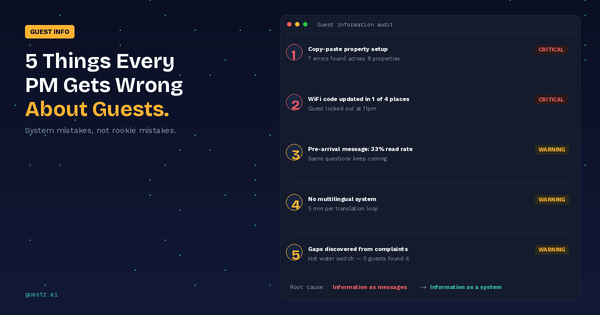
The disadvantage is everything else. You can't update information centrally — each PDF is a separate file, and if the WiFi password changes at one property you need to remember which file to edit, re-export, and redistribute. There's no multilingual support beyond creating separate PDFs in each language. Guests can't search or ask questions — they have to scroll through the document to find what they need. And there's no analytics, so you have no idea whether guests are actually reading the guide or ignoring it.
At 10+ properties, maintaining individual PDFs becomes a real time cost. Every seasonal update, every new appliance, every changed parking arrangement means opening multiple files and hoping you didn't miss one.
Plenty of successful property managers started with a Canva PDF. At three or four properties, it works. The question is when "works" starts costing more time than the subscription you're avoiding.
Nowistay — best for guidebook + AI messaging in one tool
Nowistay takes a different approach from the other tools on this list by combining a digital guidebook with an AI co-host that operates in your messaging inbox. The guidebook part works similarly to the others — you build a welcome guide with your property information, local recommendations, and house rules. Where it diverges is the AI assistant, which can respond to guest messages on platforms like Airbnb, Booking.com, and WhatsApp using information from your guidebook.
The idea is that instead of guests needing to find and read the guidebook themselves, the AI handles incoming messages and answers questions using the content you've curated. It operates in your inbox alongside you — you can review what it sends, override it, or let it handle routine questions automatically.
Pricing is structured in tiers. Creating the digital welcome guide itself is free. Publishing it online and activating the AI co-host requires a subscription. The guidebook-only tier is affordable at around €10 per property per year. The full AI co-host package — guidebook plus automated inbox responses — runs at around €90 per property per year.
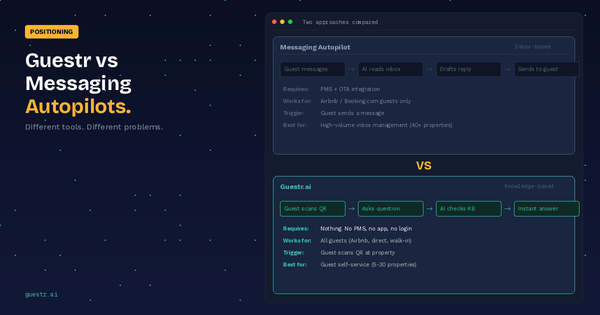
Worth noting: Nowistay's AI works in the host's inbox. The guest still messages you (or what they think is you) — the AI drafts or sends the response. It reduces your workload, but it doesn't change the communication pattern. Guests are still starting a conversation with you. The AI just handles the other end.
If you're comfortable with AI replying on your behalf and want the guidebook and inbox automation in one place, Nowistay is a solid option. If the idea of AI sending messages as "you" makes you uneasy, it's probably not the right fit.
Guestr.ai — best for AI-powered interactive Q&A at scale
Guestr approaches the digital house manual differently from every other tool on this list. Instead of creating a guide that guests read, Guestr creates a knowledge base that guests interact with. The guest scans a QR code at the property — no app download, no login, no registration — and asks whatever question they have, in whatever language they speak. The AI answers from the information you've curated for that specific property.
This is a guest-initiated model. You don't push information to guests and hope they find what they need. They ask, and the system answers. It works in 50+ languages automatically — not translated templates, but actual responses generated in the guest's language based on your approved content.
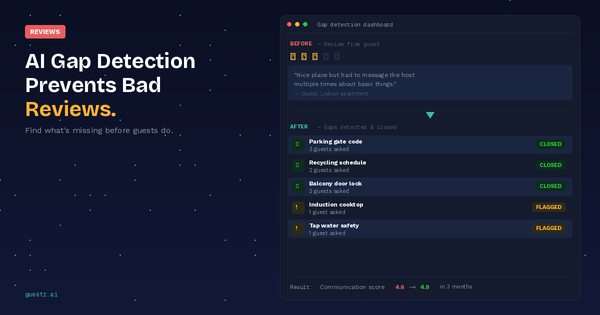
At scale, two things matter here. Each property has its own knowledge base — so the answer to "where do I put the recycling" at Property A is different from Property B, and you manage them all from one place. And there's gap detection: when guests ask questions your knowledge base doesn't cover yet, the system flags them. You fill the gaps before they show up in reviews.
Setup is fast. You add your property information, generate a QR code, place it in the property, and guests can start using it immediately. There's no PMS dependency — it works for Airbnb, direct bookings, Booking.com, or any channel because the QR code is physical and platform-independent.
Pricing starts free with no credit card required.
The key difference from other tools is the interaction model. Touch Stay and Hostfully create guides guests read. Nowistay creates an AI that responds in your inbox. Guestr creates an AI that guests talk to directly, without involving you at all unless there's something the AI can't handle. For property managers whose main problem is reactive guest messaging — questions at midnight, questions in unfamiliar languages, questions about property-specific details — that distinction matters.
Full disclosure: this is our product. We included it because it belongs in the comparison, and we tried to describe every tool here the same way — what it does, what it costs, where it falls short. If guest-initiated self-service in any language is the problem you're solving, this is what Guestr was built for.
Side-by-side comparison
| Feature | Touch Stay | Hostfully | Canva/PDF | Nowistay | Guestr.ai |
|---|---|---|---|---|---|
| AI Q&A | Chatbot (guidebook-based) | No | No | Yes (inbox) | Yes (guest-facing) |
| Languages | Manual translation | 16+ auto | Manual | Multi | 50+ auto |
| PMS required | No (limited integrations) | No (better with Hostfully PMS) | No | No | No |
| Setup time per property | 1–2 hours | 30–60 min | 2–4 hours | 30–60 min | 15–30 min |
| Works for direct bookings | Yes | Yes | Yes | Yes | Yes |
| Gap detection | No | No | No | No | Yes |
| Approx. cost/property/year | ~$42–99 | ~$96 (standalone) | Free | €10–90 | Free to start |
How to choose
Honestly, the right answer depends on what's actually eating your time.
If your guests would stop messaging you if they just had a nice-looking guide with all the information in one place — Touch Stay or Hostfully will handle that. If budget is the constraint and you only have a few properties, a well-made PDF works fine until it doesn't.
If the volume of inbox messages is the bottleneck and you want AI handling replies, Nowistay does that. If the problem is that guests need answers outside your scheduled messages — in languages you don't speak, at hours you're asleep — that's a different category of problem, and it's the one Guestr was built around.
None of these tools is universally better. They solve different problems. Pick the one that matches your bottleneck, not the one with the longest feature list.
Try Guestr free — no credit card required. Start free →
Written by the Guestr.ai Team · guestr.ai