How to Handle Guest Questions in 50+ Languages Without Speaking Any of Them
Your guests speak 15 languages. You speak two. Property managers with international guest bases don't need multilingual staff — they need a system that answers in the guest's language from content written once, in yours.
Last summer I managed a cabin in Lofoten that hosted a Japanese couple in June, a German family in July, and a group of Americans in August. Same property, same check-in instructions, same quirky wood stove that confuses everyone. Three completely different languages hitting my inbox.
This isn't unusual if you manage properties in tourist areas. It's the default. European short-term rental operators routinely welcome guests from ten or fifteen different countries in a single season. The questions are always the same — WiFi, parking, how the heating works — but they arrive in languages you've never studied and at hours when no translator is available.
So what actually works? Not hiring multilingual staff (the math doesn't hold). Not Google Translate copy-paste (your guests can tell). What works is building a system where the guest gets a competent answer in their language without you being involved at all.
Where Language Barriers Actually Cost You Money
The costs aren't abstract. They show up in specific, predictable moments during a guest's stay.
Before arrival: You send check-in instructions in English. Your German guest reads them, mostly understands, but isn't sure about one detail — the key box location. They arrive at 9pm, can't find it, and call you. You spend 20 minutes on the phone trying to explain something that would take 10 seconds if you both spoke the same language.
During the stay: A Spanish guest wants to know how the induction hob works. They send you a message in Spanish. You screenshot it, paste it into Google Translate, read a rough English version, type your reply in English, wonder if you should translate it back to Spanish, decide you don't have time, and send it in English hoping they'll manage. Total time: 8 minutes for a question that had a 30-second answer.
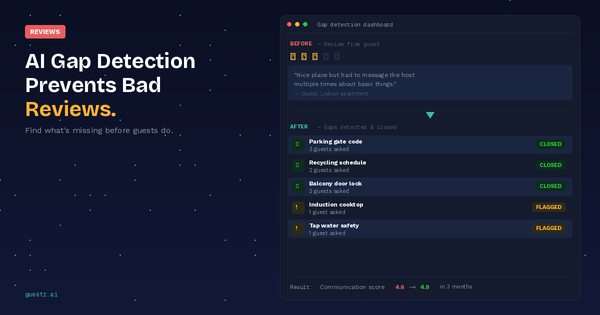
After checkout: A French guest leaves a 3-star review. The property was fine. The bed was comfortable. But they write that communication was difficult and they couldn't get clear answers to basic questions during their stay. That review sits on your listing for months.
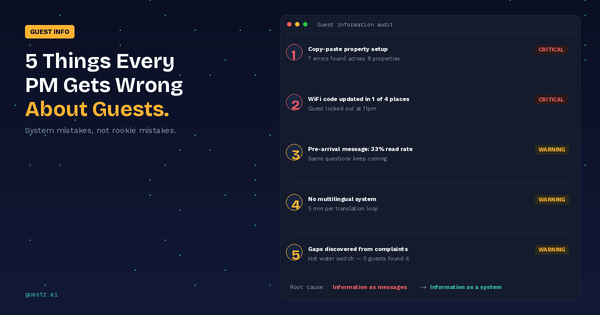
The pattern across all three: your property information exists, but it's locked in a language the guest doesn't read fluently. The information failure isn't about what you know — it's about what they can access.
The Multilingual Staff Fantasy
One instinct is to hire someone who speaks the languages your guests speak. Let's look at what that actually requires.
If you manage 12 properties across Norway with guests arriving from Germany, France, Japan, the UK, Spain, the Netherlands, and South Korea — that's seven languages minimum. Finding one person who speaks all seven is essentially impossible. Finding three people who collectively cover them is expensive and still leaves gaps.
Even if you find coverage, guest questions don't arrive during business hours. The German guest who can't find the parking spot texts at 11pm on a Saturday. The Japanese guest who can't figure out the washing machine sends a message at 6am. Multilingual staffing that covers evenings and weekends across seven languages isn't a staffing plan — it's a fantasy budget line.
The alternative isn't better people. It's a system that doesn't depend on who happens to be awake and what languages they happen to speak.
Why Google Translate Creates More Problems Than It Solves
Every property manager has tried the copy-paste workflow. Guest sends a message in Portuguese. You paste it into Google Translate, read the English version, type a reply in English, maybe translate it back, and send it.
It works — kind of. For simple questions, the translation is usually close enough. But it breaks down in ways you don't always notice immediately.
The most visible problem: grammatical errors in the translated reply signal to the guest that you didn't actually understand their question. A sentence that reads awkwardly in Portuguese doesn't build confidence that the parking instructions are correct.
Then there's the repetition tax. There's no memory in this workflow. The next Portuguese guest asks the exact same question, and you go through the entire process again. At five languages and fifteen properties, the copy-paste minutes add up to hours.
But the thing people underestimate most is that translation apps translate words, not intent. When a guest types "Wo ist der Schlüsselkasten?" they want to know where the key box is. A translation tool gives you the English words. What the guest actually needs is the specific location, described clearly, with enough context that they find it on the first try. Translating words back and forth doesn't get you there reliably.
The Difference Between Translating Messages and Answering in the Guest's Language
This is a distinction worth sitting with for a moment, because it changes how you think about the problem.
Most tools in this space — and most property managers doing it manually — are translating messages. You receive a message in German, translate it to English, compose a response in English, translate it back to German. The guest gets an answer, but it's been through four translation steps, and you were the bottleneck at every stage.
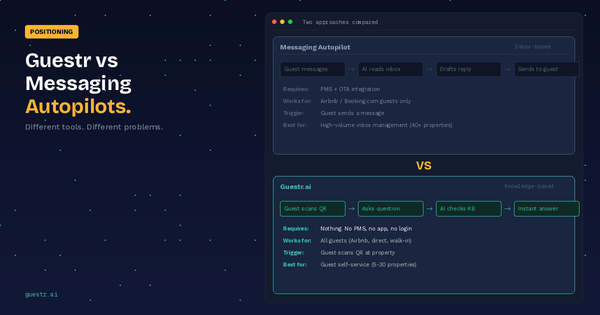
The alternative is a system that answers directly in the guest's language. The guest asks their question in German. The system finds the relevant property information (which you wrote in English, once) and generates the answer in German. No round-trip. No copy-paste. No waiting for you to wake up.
This is what AI-powered knowledge systems do well. Not translating your messages — answering the guest's question from your content, in whatever language they're comfortable with. The guest gets a faster, more natural response. You don't get interrupted.
For property managers with five or more languages hitting their inbox each month, that difference is the line between a system that scales and one that adds work for every new booking.
Building a Knowledge Base That Works in Every Language
Here's where this gets practical.
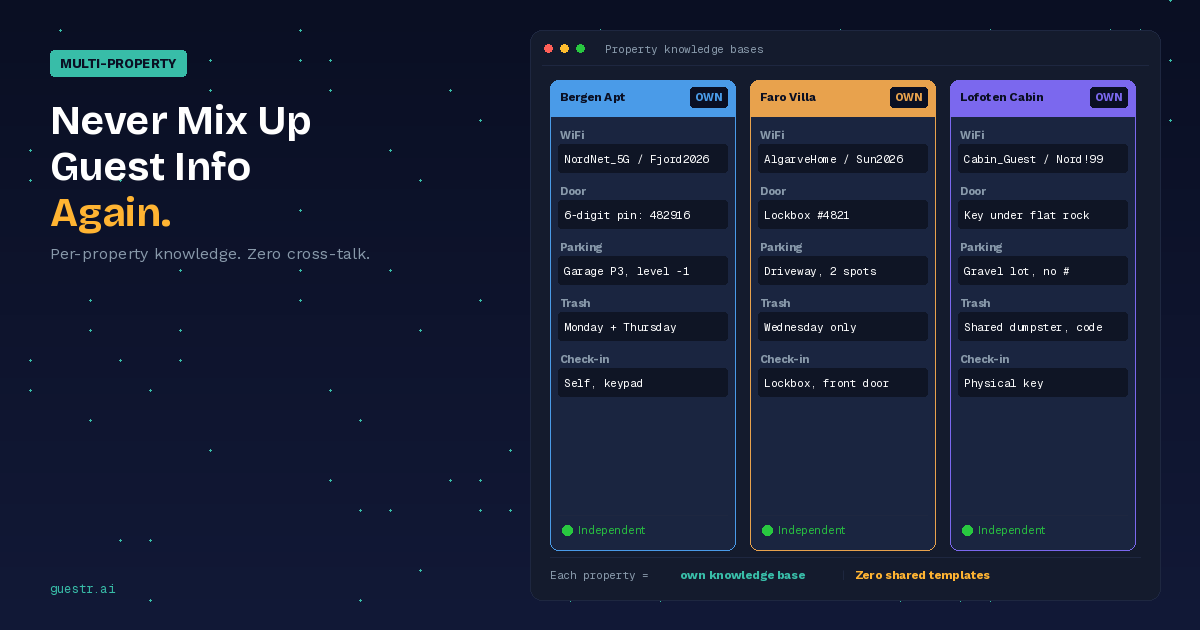
You write your property information once — in English, or whatever your working language is. Check-in instructions, WiFi details, appliance guides, parking rules, house rules, local recommendations, emergency contacts. The same stuff you'd put in a house manual, just structured so an AI can find the right piece when a guest asks for it.
That content becomes the knowledge base for that property. When a guest asks a question — in Japanese, in German, in Norwegian — the AI retrieves the relevant answer from your English content and responds in their language. You don't translate anything. You don't even see the interaction unless you want to.
What makes this different from generic AI (like asking ChatGPT a question about your property) is the constraint. The AI can only answer from what you've put into the knowledge base. It won't invent a WiFi password. It won't guess your checkout time. If the information isn't there, it says so — and that gap gets flagged for you to fill.
The per-property setup takes about 30 minutes. If you've already got a house manual or digital guidebook, most of that content transfers directly — you're just reorganising it so the AI can retrieve specific answers rather than asking guests to scroll through pages looking for what they need.
Friday Evening, Lofoten: What This Looks Like in Practice
Here's a scenario that plays out regularly for property managers in tourist destinations.
It's 7pm on a Friday in October. A German couple has just arrived at your Lofoten cabin after a long drive from Bodø. They're tired, it's getting dark, and they can't figure out how the front door lock works. It's a specific type of electronic lock — you need to hold the handle up, then enter the code. Not intuitive if you've never seen one.
Without a self-service system: the guest sends you a message in German. Maybe you're at dinner. Maybe you see it in 20 minutes. You translate it, figure out what they're asking, type a reply explaining the lock mechanism, hope the translation makes sense. The guest has been standing outside in the cold for half an hour.
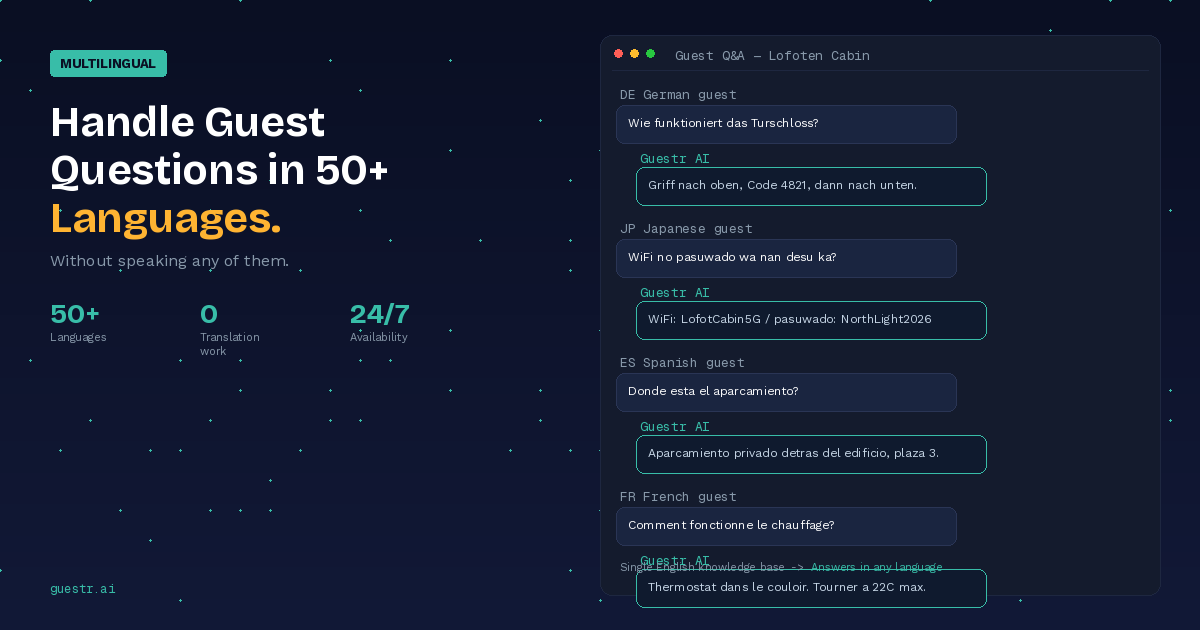
With a knowledge base that speaks their language: the guest scans the QR code on the door (you placed it there for exactly this reason). They type "Wie funktioniert das Türschloss?" — how does the door lock work? The AI pulls your lock instructions from the property knowledge base and responds in German: lift the handle up, then press the four-digit code, then push down. The guest is inside in 30 seconds. You find out about it on Monday when you check the interaction log.
That's not a marginal improvement. For the guest, it's the difference between frustration and a smooth arrival. For you, it's a Friday evening you didn't lose to a message that had a known answer.
Getting Started Without Overcomplicating It
If you're managing properties with an international guest base and you're still handling language barriers manually, the first step isn't a full system overhaul. It's picking your highest-traffic property — the one that generates the most guest questions — and building a knowledge base for it.
Populate it with the information guests ask about most: access codes, WiFi, appliances, parking, local essentials. That takes one session. Generate a QR code for that property (here's how to set that up). Place it at the entrance.
The next time a guest arrives speaking a language you don't, they scan, ask, and get an answer from your content — in their language, at any hour.
50+ languages. Zero translation work on your end. Guestr lets guests ask questions in their language and answers from your curated property knowledge base — accurately, instantly, any time of day.