The Hidden Cost of Repetitive Guest Messaging (And How to Fix It)
WiFi, check-in, parking, checkout, heating. The same five questions, every guest, every property. At 10 properties that's 200+ messages a month. Here's what that actually costs you.
I want to talk about something that every property manager knows is a problem but nobody actually measures. The time you spend answering the same guest questions over and over.
Not the interesting questions — the unusual requests, the special occasions, the guests who need genuine help. Those are worth your time. I'm talking about "what's the WiFi password?" for the fourth time this week. "Where do I park?" at 9pm on a Friday. "How does the coffee machine work?" when you wrote it in the welcome message they didn't read.
You know the questions. You could answer them in your sleep. And that's exactly the problem — you shouldn't have to.
The Five Questions You Answer Every Week
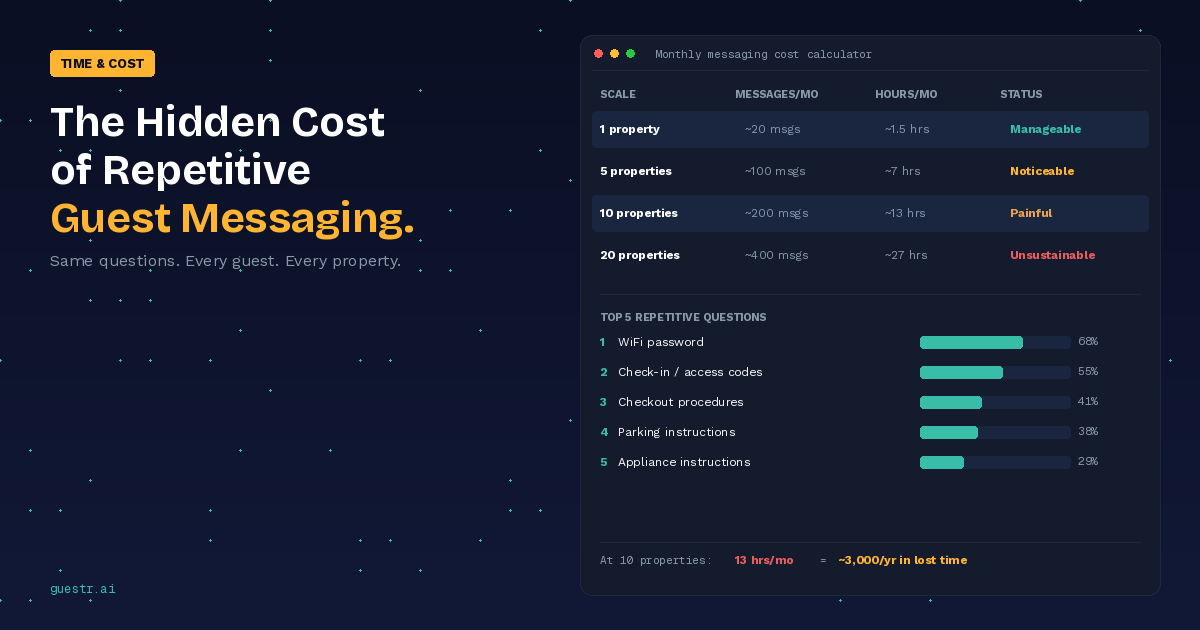
I tracked my own messages across 8 properties for a month last year. These five made up about 70% of everything guests asked:
WiFi password. Every single guest. Even when it's in the welcome message, taped to the router, and printed in the house manual. They still ask.
Check-in and access codes. "Which door?" "Is it the top or bottom keypad?" "The code isn't working" (it is — they're using last month's code from a different property's message).
Checkout procedures. When to leave, where to put the keys, what to do with the bins and the towels. Guests ask this the morning of checkout even though you sent it two days ago.
Parking. Where it is, whether it's free, which spot is theirs, whether they need a permit. This one generates the most frustrated messages because guests are usually sitting in the car when they ask.
Appliances. The heating thermostat, the TV remote, the washing machine, the dishwasher. Every property has at least one appliance that confuses people, and it's never the one you'd expect.
There's nothing surprising on this list. You already knew all five. The question is: how much time do they actually take?
The Math Nobody Does
Here's a rough calculation that changed how I think about this.
Each of those messages takes about 4 minutes to handle. Not just typing the reply — finding the right information for the right property, making sure you're sending the correct code (not the one from the apartment two streets over), and actually sending it. Some take 2 minutes, some take 8 when you need to check something. Call it 4 on average.
At one property with decent occupancy, you'll get maybe 15–20 of these routine questions per month. That's about an hour. Manageable.
At 5 properties: 75–100 questions. That's 5–7 hours a month. Starting to feel it.
At 10 properties: 150–200 questions. You're now spending 10–13 hours a month on messages that have the same answer every time. That's a day and a half of work, every month, repeating yourself.
At 20 properties: you can do the multiplication. It's bad.
And this is just the direct time. It doesn't account for the interruptions — the message that arrives during dinner, the checkout question at 7am on Sunday, the WiFi password request while you're showing a potential property owner around. Each interruption costs you more than the 4 minutes of typing. It breaks whatever you were doing, and it takes time to get back to it.
Put a number on your hourly rate. Even at a modest €25/hour, 10 hours of repetitive messaging per month is €250. That's €3,000 a year, spent typing things you already know to people who already have the information somewhere.
It's not catastrophic. Nobody goes bankrupt answering WiFi questions. But it's the kind of slow leak that drains your time without you ever deciding to spend it.
Why Quick Replies and Templates Only Fix Half the Problem
The obvious first move is templates. Save your five most common answers, tap-tap-send. And yes, this helps — it cuts the 4 minutes down to maybe 1 minute per message.
But templates don't solve three things.
They don't help at 11pm. You still need to see the message, open it, pick the right template, and send it. If you're asleep, the guest waits until morning. If the guest can't get in because the code isn't working, "morning" isn't good enough.
They don't help across languages. A German guest sends a question in German. Your template is in English. You can send it and hope, or you can spend 5 minutes translating. Either way, the template didn't save you much.
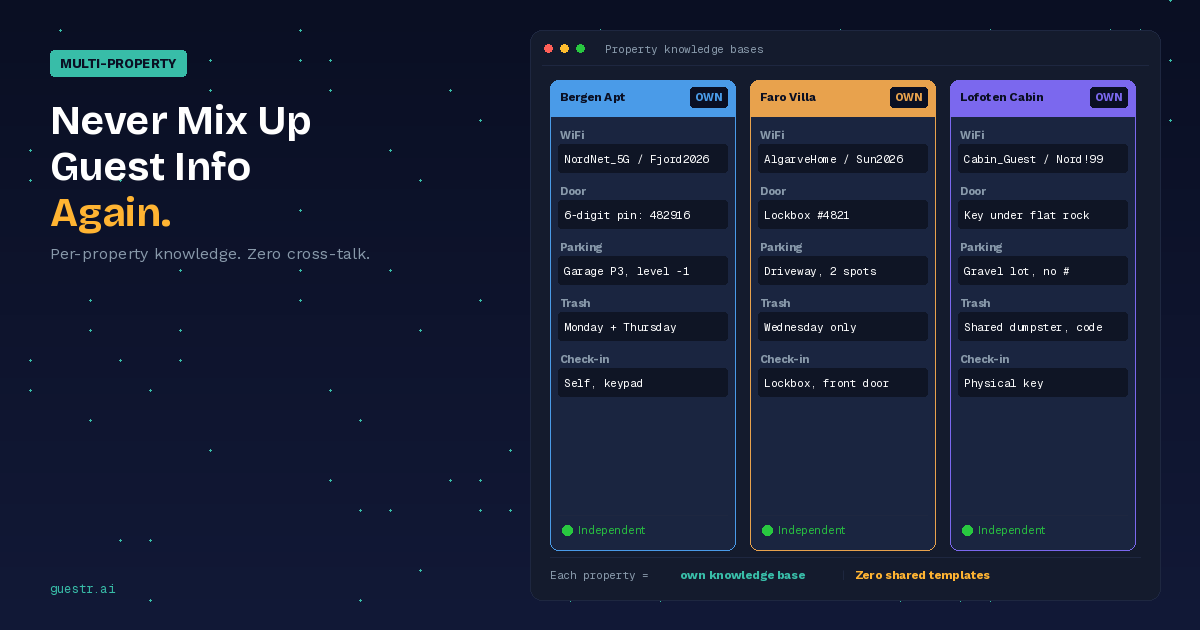
And they don't prevent the wrong-property mistake. When you manage 10+ properties and you're replying quickly, it's easy to send Property B's parking instructions to Property A's guest. Templates organized by property help, but the risk doesn't disappear — especially late at night when you're tired and the message just says "where do I park?"
Templates make you faster at answering. They don't make the questions stop.
The Difference Between Answering Faster and Not Needing to Answer
This is the part where most articles would say "just send better pre-arrival messages" or "use scheduled messages." I've written about why scheduled messages only go so far. They help with timing, but they don't help when the guest has a question you didn't anticipate or can't find the answer you already sent.
The shift that actually reduces your message count isn't about sending more information to guests. It's about giving them a way to find it themselves.
Think about the last 20 routine questions you answered. How many of those had an answer that already existed somewhere — in your listing, in your welcome message, in your house manual? Probably most of them. The guest just couldn't find it, or didn't look, or got the message at the wrong time, or speaks a different language than the one you wrote it in.
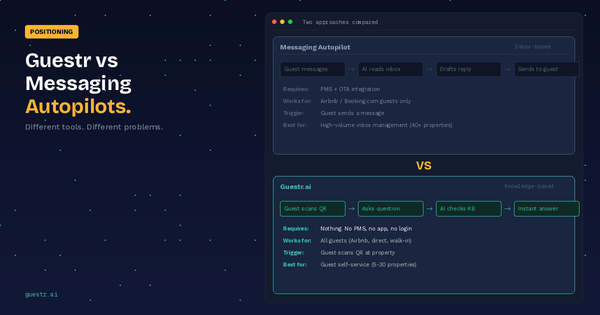
When guests can pull up a QR code and ask "where do I park?" and get a property-specific answer instantly — in their language, at 11pm — that question never reaches your inbox. Not because you ignored it, but because the guest already has what they need.
That's the difference between being faster at answering and the question never needing to be asked in the first place.
What Changes When You Fix This
I don't want to oversell it. You're not going to eliminate all guest messages, and you shouldn't want to. Some questions need a human — the guest whose flight got delayed, the one asking about a surprise anniversary dinner, the plumbing emergency. Those deserve your attention, and you can actually give it when you're not buried under WiFi password requests.
What realistically changes at 10 properties: instead of 200 routine messages a month, maybe 40–50 still come through — the edge cases, the unusual situations, the things that genuinely need you. That's 10 hours of your month back. It's the equivalent of gaining a free day and a half every month to spend on the parts of property management that actually grow your business.
The questions that remain are also more interesting. Instead of "what's the WiFi?" you're getting "can you recommend a good restaurant for our anniversary?" — and that's a message worth answering.
Guestr handles the routine so you can handle the relationship. Your guests get instant, property-specific answers to the same questions that currently fill your inbox — in 50+ languages, at any hour.
Try Guestr free — 30 days, no credit card →
Related: Why Scheduled Messages Aren't Enough for Guest Communication · Handle Guest Questions in 50+ Languages